
| Swansea City 4 v 0 Blackburn Rovers EFL Championship Saturday, 31st October 2026 Kick-off 15:00 |  |
Swansea MY Swansea MY City said I Friday, 30th Oct 2026 16:36 by Rhys Clayton Swansea Town and Swansea RFC have played a huge role in the sporting landscape of south-west Wales. With Swansea City set to play Blackburn Rovers tomorrow, Rhys Clayton takes a look at the sporting heritage of the city, and links it back to a famous game against Rovers all the way back in 1915. Quiz question: which bird is represented most often on the outside of the Swansea.com Stadium? Clue, it is not a swan. A large Swansea City logo adorns the West Stand, but to the left, you will find two ospreys. The symbol in the middle includes a red osprey on the Swansea Council sign, and further left is the Ospreys rugby club badge. Originally a Maltese cross for Neath and an overlaid osprey for Swansea, the badge was simplified in 2008 to a mask outline with the word "Ospreys" writ large underneath. Why an osprey? Well, contrary to what football fans might think, the osprey is the bird historically associated with the area. Indeed, the origin of the name Swansea has more to do with Old Norse than anything to do with the family Anatidae (which covers ducks, geese and swans). The use of an osprey on heraldic symbolism goes back to the 14th century, while the current official coat of arms, which includes a castle, a red lion (from the de Braos family arms), a red dragon, and an osprey holding a fish in its beak, has been used by the council since 1922. The Latin inscription, Floreat Swansea - let Swansea flourish, stands below. Eagle-eyed citizens (no pun intended) will have noticed some "new" old signage appearing in Swansea. Back in March, the council announced that updated street signs would feature the traditional arms. Uplands Terrace (below) in Morriston, a short walk from the stadium, was the first street sign to be updated. 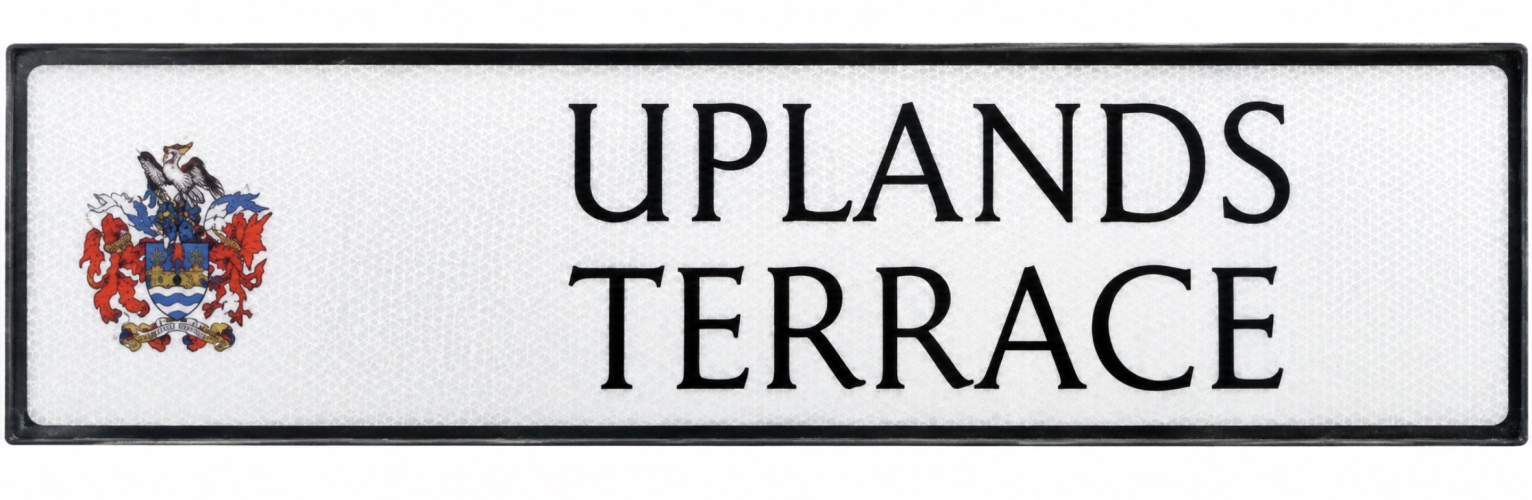 Anyone living in the Swansea area with a vague interest in local affairs will know where I am going with this. Last Saturday, the Ospreys rugby team returned to their spiritual home of St Helen's, beating the Dragons in a sold-out stadium. Countless photos and videos flooded my timeline, including some stunning aerial shots, showing the contrasting touchline pyrotechnics with the dark, gloomy skies going all the way out to Mumbles. Sport lovers would have been delighted with the public response, especially as the Ospreys fight for their lives to simply exist beyond the following season. That Wales' second city could be without a professional rugby team is utter madness, and would be a stain on the Welsh sporting landscape. For St Helen's has witnessed sporting history. The ground has held football and rugby league internationals, seen the greatest cricketer of all time, Sir Don Bradman, grace its turf, played host to the first-ever instance of six sixes in an over by the greatest all-rounder of all time, Sir Garfield Sobers, and staged Wales' first-ever home rugby union international. Swansea RFC were the first club side to ever beat the mighty All Blacks in 1935, thus becoming also the first club side to conquer New Zealand, South Africa and Australia. (below) In 1928, a 13-year-old Dylan Thomas won the school mile race at St Helen's. We know this memory stayed with Thomas until his dying days, when, in 1953 after he passed away in New York, a newspaper clipping of that very Swansea Grammar School victory was found folded inside his wallet. 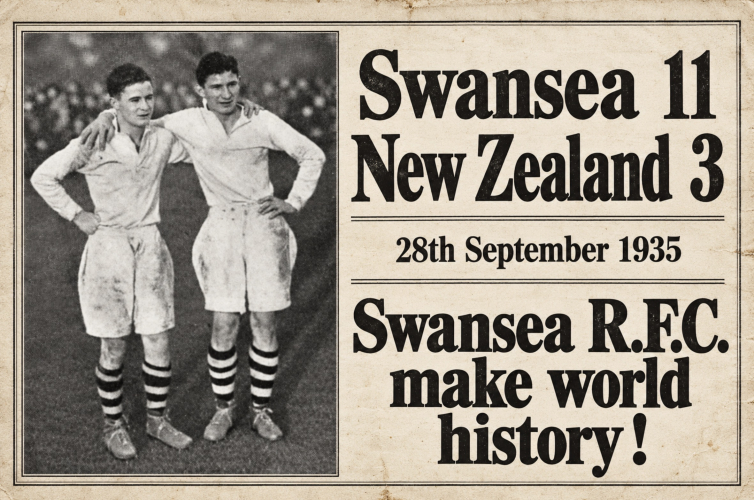 Haydn Tanner and Willie Davies 1935 THE " SCHOOL-BOY " HALVES: W. T. H. Davies,left and Tanner of Gowerton School Benjamin "Benny" Beynon would once have run out on the sandy turf alongside Gower Road. Likewise, the old cabbage patch once known as The Vetch hosted the multitalented Beynon too. The WWI veteran of the Welsh Regiment, 38th Division was born in Swansea in 1894, and is probably the most famous "dual code" Swansea boy. He represented Wales twice in rugby union, and completed his sporting code hat-trick with a four-year spell in rugby league with Oldham, winning a Challenge Cup in 1925. His debut for the national team against England at St Helen's in 1920 saw him become the 300th player to represent Wales. The WRU, however, withheld his caps, since it was believed he had been a professional while at Swansea Town, and this possibly prevented him from further caps. With the round ball, his best moment for the Swans came in January 1915. (below) Facing the mighty First Division Blackburn Rovers in the FA Cup, Beynon would score the only goal in a 1-0 win. It was the Swans' first giant-killing, remarkably coming in our first appearance in the Cup. Not many cup wins rival that victory in the subsequent 100 years. 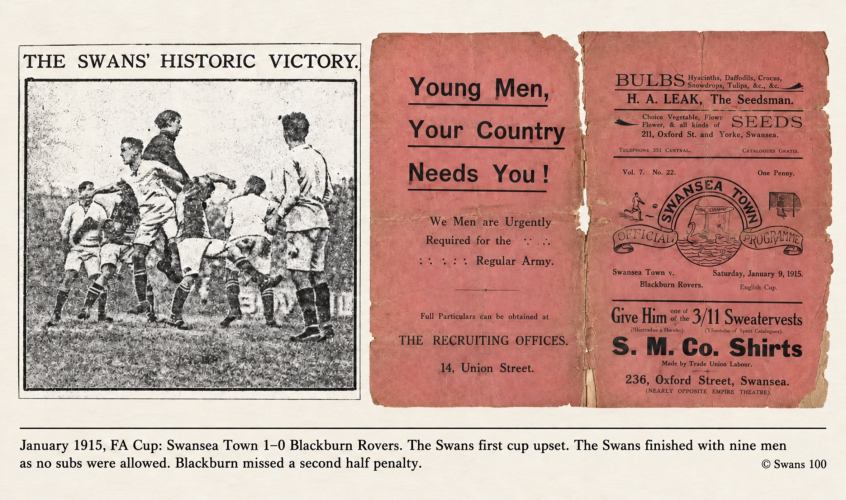 The South Wales Daily Post reported jubilant scenes at the final whistle. "Duffy was carried shoulder high to the pavilion where a dense crowd congregated, and patted the players on the back as they went back to the dressing room. Cheer after cheer was raised for the Swans, and one of the spectators called out to Bullock, telling the Swansea skipper that the Cup ought to be presented to Swansea straight away after their magnificent victory." WWI had already begun by that mid-winter, which subdued its impact across the nation. "But for the fact that there is a war on, the Swans’ success would be emblazoned forth to all quarters of the world, and their praises would be loudly sung all over the country." Beynon died in May 1969, just two months before it would be announced his hometown would soon be his home city. Fittingly, the Swans host 10th-placed Blackburn Rovers on Saturday afternoon. Three miles down the road, the Ospreys host 10th-placed Cardiff Rugby on Saturday evening. Let the Swansea teams flourish. 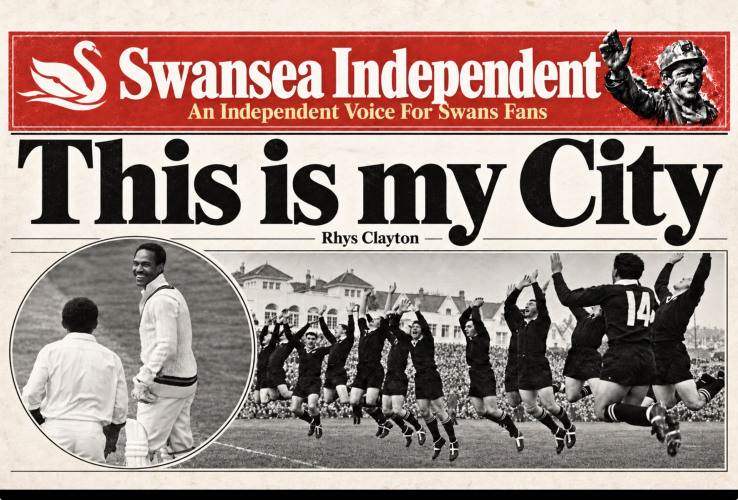   Photographs : Swans 100, Swansea University, See disclaimer, artwork TNTclick Media Please report offensive, libellous or inappropriate posts by using the links provided.
You need to login in order to post your comments |
   Swansea City Polls[ Vote here ] |