Please log in or register. Registered visitors get fewer ads.
A Rough Guide To Wembley
Thursday, 23rd Apr 2026 09:37

Here we go for what we hope will not be our last appearance at Wembley this season, all the information you will need for a great day, including the Pub's & bars allocated to Southampton supporters, keep coming back as the information could well be updated in the next few days.

The Stadium

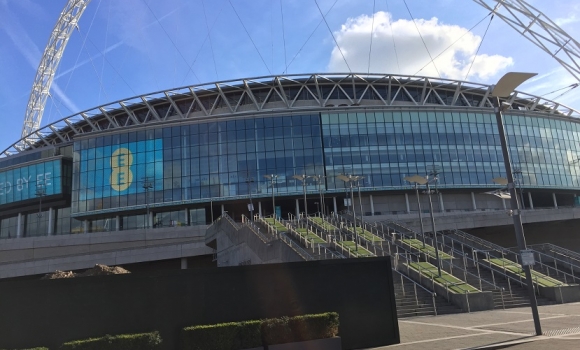
The old stadium was an icon with it's twin towers, so that meant the new one had to have something as stunning and that has been achieved through the arch that can be seen from many miles around.

However for many it will never match the old stadium, with its history of not only the 1966 World Cup final win by England, but also the days when FA Cup finals meant something.

The ground opened in March 2007 with the second public game there being the FA Vase final between AFC Totton and Truro with the Cornish team unfortunately being victorious.

The stadium is totally enclosed and comprises three tiers, with both sides of the stadium being slightly larger than the ends. These sides are semi circular in construction but unlike the old Wembley are fairly close to the pitch so it has a feeling of being a football ground, something which the old stadium certainly didn't have.

The stands have large upper and lower tiers, with a smaller middle tier sandwiched in-between. This middle tier overhangs the lower tier and has a row of executive boxes at the back of it.

At each end there is a large video screen, which is moulded into the third and hence is an integral part of the stadium although this does take out part of the upper tier seating behind each goal.

The stadium has a complicated looking roof, that initially appears retractable and could if necessary be used to enclose the stadium from the outside elements. However, just over one third can be moved, so that the pitch will always be open to the elements. We of course took part in the first ever Cup Final to be played "indoors" when due to heavy rain in Cardiff in 2003 the roof at the stadium was closed.
Entering The Stadium

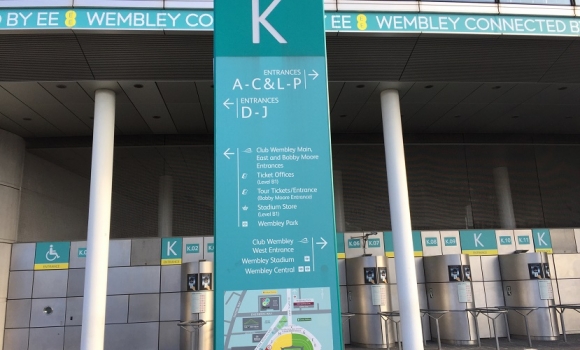
Getting into the ground is easy and when in inside there are spacious concourses, however if you are on level 5 the upper tier it is a bit of climb, however there are escalators to help you on your way.

Saints have been allocated the West End of the stadium, this is the same end we were allocated for the 2024 Play Off Final, the 2019 FA Cup semi final, the 2017 League Cup final and the 2010 Johnstones Paint Trophy final.

The Concourses

The concourses at Wembley unlike most football grounds are big spacious and bright, meaning that there is plenty of room to move around and sometimes entertainment beyond the usual TV screens is provided.

There are many toilets and refreshment kiosks and because of the space available there are also guest kiosks as well as the permanent ones. These pop up kiosks serve everything from Krispy Kreme Donuts to guest real ales. Apparently there are is one till for every 100 spectators in the stadium meaning that getting served is usually quick and easy.

It is not cheap though and Wembley has always had a reputation for being expensive for food and drink, however it is not that much different to the prices charged at London Premier League grounds. Expect to pay a lot more for a beer in the stadium than in a pub depending on the outlet and the size of the drink.

Most of the outlets also take card payments.
Pyrotechnics.

The use of pyrotechnics, flares and smoke devices inside or outside Wembley Stadium is illegal and prohibited. Anyone caught carrying or using pyrotechnical equipment inside the stadium will be immediately ejected from the stadium, banned from future events and dealt with by police. Those caught using pyrotechnic equipment anywhere outside of the stadium will be in breach of the PSPO order and face enforcement action.

Restricted bag policy.

Wembley Stadium operates a restricted bag policy. Each person can only bring one small bag into the stadium, and it must not be bigger than A4 size:
Height – 297mm (11.7 inches) - Width – 210mm (8.27 inches) - Depth – 210mm (8.27 inches)

Please note, this means the overall bag size – bags that are half-full and folded over to reduce their size will not be accepted. Anyone carrying bags that do not meet the criteria above will not be allowed into the stadium

Persistent standing
Persistent standing during a match at Wembley Stadium is strictly forbidden (unless with a ticket for the safe standing area) and may result in ejection from the ground. Persistent standing not only compromises crowd safety, but also affects the matchday experience of fellow spectators, especially children and elderly people.
Anti-social and discriminatory behaviour

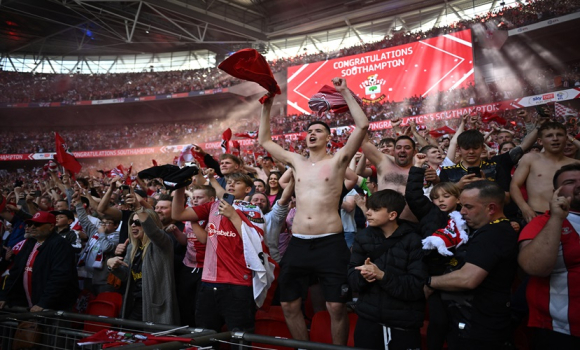
Wembley Stadium operates a zero-tolerance policy on any form of anti-social and discriminatory behaviour. If you witness any anti-social or discriminatory behaviour on the day, text HELP to 66566 or contact your nearest steward.

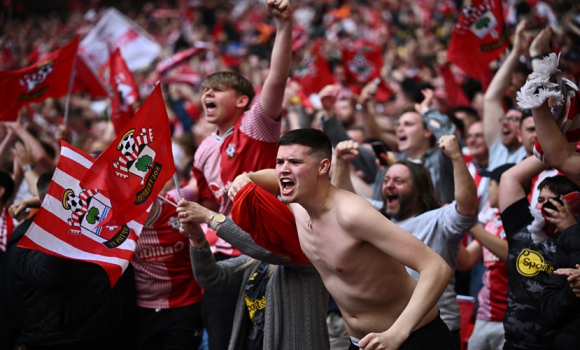
Flags are permitted without approval if they meet guidelines. They must be under 250cm at their widest point, or 200cm x 100cm for Level 5.

They cannot display advertising or offensive messages.

Flagpoles are generally not allowed unless they are plastic and under 1m in length. Larger flags require advance permission from organisers.
Around The Stadium

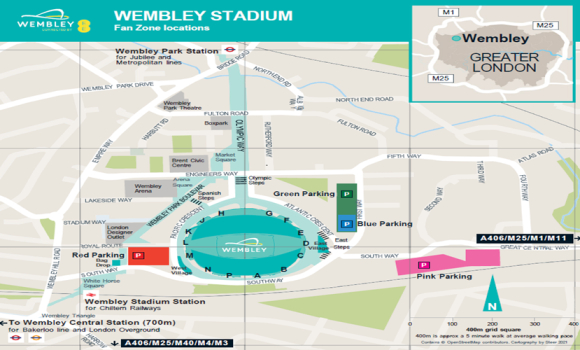
As most will know from our previous article the pubs around the stadium have been allocated to each set of supporters, in general all of our allocated pubs are around the Harrow Road/Wembley High Road area which is behind the West End of the stadium in which we are situated.

Those refusing to surrender alcohol face a £100 fine, while public urination is strictly prohibited and is also subject to an immediate £100 penalty.

There is also a zero-tolerance policy on flares and smoke devices, with offenders risking hefty fines and the cancellation of their match ticket.

However, supporters are encouraged to use the bars and fan zones in the area and are advised to book in advance where possible to secure entry.

The Saints fan zone will be on the west side of the stadium concourse (West Village) and will be open from 1.15pm. Other Saints venues include:

Crystals (Sports Bar & Aqua Lounge)
Address: 1 Popin Building, Southway, Wembley, HA9 0HB
Contact: 0203 576 5765 / 07985 195277

The Arch
Address: 324 Harrow Rd, Wembley, HA9 6LL
Contact: 0208 127 1141

Station 31
Address: 299-303 Harrow Rd, Wembley, HA9 6BD
Contact: 0208 900 0173

The Robin
Address: 397A High Rd, Wembley, HA9 6AA
Contact: 020 8903 0159

JJ Moons
Address: 397 High Rd, Wembley, HA9 6AA
Contact: 020 8903 4923

The Corner House
Address: 313 Harrow Road, Wembley, HA9 6BA
Contact: 0203 784 2021

Black Sheep
Address: 5 White Horse Square, South Way, Wembley, HA9 0HZ
Contact: Not listed

The Green Man
Address: Dagmar Avenue, Wembley, HA9 8DF
Contact: 0208 903 1441 / 07595 051937

Sixty Six Bar & Grill
Address: 3 South Way, Wembley, HA9 0JU
Contact: 07447 098752

La Regina (St George’s Hotel)
Address: 43-51 Wembley Hill Road, Wembley, HA9 8AU
Contact: 0208 900 0662

The White Horse
Address: 4 Wembley Park Boulevard, Wembley, HA9 0HP
Contact: 0208 237 8037

Boxpark Wembley
Address: 18 Olympic Way, Wembley, HA9 0JT
Contact: 020 7186 8800
Tickets and entry information

All tickets for the match will be issued digitally via the Saints Tickets app, with fans advised to download and check their tickets before travelling.

Tickets are sent to the email address linked to each booking, and QR codes for stadium entry will become available shortly before matchday.

Supporters can transfer tickets to others, but resale is not permitted. Anyone without a valid ticket should not attempt to attend or face sanctions.

Assistance will be available at the West Ticket Office for urgent issues.


All Photos Via Reuters


Please report offensive, libellous or inappropriate posts by using the links provided.


jameshill added 10:08 - Apr 23
With Wembley in mind -calling all bedwetters – especially the Jack Stephens moaners.
Jack Stephens our captain, a loyal mainstay of our club and team for many, many seasons. The guy who got the last-minute winner against Wrexham on the first game of the season.
Yea, that Jack Stephens.
What’s happened? Where are you? On holiday perhaps? Its all gone very quiet over there!

Then again what about all you moaning minnies who knew that Sports Republic couldn’t run a piss up in a brewery etc. Have you had a chance recently to wonder who took the bold choice of Tonda and talk me through the calamitous thinking that found Peretz and Larin from seemingly nowhere to say nothing of getting Scienza and Azaz in the summer?
You could say they even had the savvy to say cheerio (unfortunately only temporarily) to
Downs and Bazunu.

It takes no guts and intelligence to complain when things don’t go as you wish, football will always be one day up one day down (unless youre Man City) but I hope you really are not on your holidays – you really wouldn’t want to miss Saturday. Its going to be mental! COYY!
0

ThermosNBlanket added 10:21 - Apr 23
I’m still here and moaning why because we gave him a 3 year deal when we didn’t need to his contract had another year.
What part next season do you see him playing if we get promoted?
We moaned because we were playing a back 5 which doesn’t suit him now we have switched to a 4 and Bree covering he has been very good hindsight is great isn’t it!
People moan about what is happening at that time posting against that months later when the situation is different is easy.
2

saintmark1976 added 18:44 - Apr 23
Jameshill, I assume you are referring to the same Sports Republic Owners and their employees who handicapped us for a quarter of the current season by the appointment of Will Still, let alone any number of managers before him ?

As for moaning minnies. Strange how things have got better since we asked for ( and got ) a half decent centre forward and goalkeeper together with a switch to a back four defence.

Enjoy yourself at Wembley, quite a few of us still remain that were there for our F A Cup winning appearance in 1976.
0


You need to login in order to post your comments

Blogs 31 bloggers

United by Football, Divided by Race? Swansea City’s Asian Footballers and Racism in British Football by KeithHaynes
Harrison who is studying towards a media qualification has written a very interesting piece on racism in football. It’s a very clear and well documented report. Follow him on X. @HYE15h.

Football is often seen as a sport with a unique power to bring people together, connecting people from all over the world with different cultures, races and religions. 128 nations have featured in the topflight of English football, including 12 Asian nations. I have seen for myself how football connects people who otherwise have little in common through my support of Swansea City. These connections are epitomised by an exchange I had with South Korean tourists during a visit to London in August 2015. My three brothers and I were wearing our Swansea shirts, which South Korean tourists recognised because the South Korean captain, Ki Sung-yueng, was playing for our team. We connected over our shared admiration for Ki before having photos together.

However, despite the unity football creates, racial incidents challenge the belief that football is a game for all. Kick It Out data shows there were 1,744 reports of discrimination, a record high last season, whilst racism reports against South Asians increased by 100%. This season we’ve already seen racial abuse allegedly directed at Swansea City’s Ji-Sung Eom during a game against Millwall. Former Swansea British Asian player Yan Dhanda was also subjected to racist messages online in 2021. Ki’s experience of racist chanting in Scotland in 2010 before joining Swansea shows that racism against Asians in British football is not a new phenomenon. In light of these incidents I will analyse the impacts of racial abuse against Asian players and football more widely, and ask if enough is being done to stop it.

There are a multitude of different impacts from racial abuse within football, most notably the damage to player welfare. Yan Dhanda talked about the hurt he felt in the aftermath of his attack, stating how it affected both his family and how he was in training. Research by Osinnowo Kolawole reveals how the long-term emotional damage of racism is often unseen, affecting both personal lives and their performance. Racism can also lead players to question whether they want to continue playing football, as seen with Danny Rose. Osinnowo further states how racial trauma can lead to deep internal conflicts, with players altering their appearances to conform to white norms in football. For Lee Chun-Soo a former South Korean international footballer racist abuse left him with a desire to build a larger physique as a way of preventing further abuse. He believes the racial stereotypes about Asian players being small and weak results in a reluctance to recognise Asian players as equal competitors. This provides an example of an Asian player having to change who he is to be accepted into the sport, Lee and other victims of racism state how it can lead them to question their sense of belonging in the game. Premier League video content creator Kevin Yuan often faces racist abuse when filming at UK stadiums, despite living in the UK and following football since 2008, he states how he “feels like a foreigner, like I don’t fit in”.

This challenge to a player’s sense of not belonging within the game has also had a severe impact on Asian participation with football in Britain, with just over 1% of professional players being of South Asian heritage. Whilst there are many factors which underpin this underrepresentation, racial abuse definitely plays a role. Research by Dr Stefan Lawrence reveals that overt racism within football academies from other players, makes British Asians feel like outsiders. Yan Dhanda talks about how during his time in football academies he was always told he wouldn’t make it due to his Asian background. For other Asian players lacking self-belief and support, abuse can prevent progression. Separate Asian teams and leagues have emerged in direct response to racism; these are seen as safe spaces for Asian players. Dr Lawrence has found that these separate teams and leagues do not have the same level of exposure as mainstream leagues, whereby they aren’t seen by scouts as repositories of talent. Furthermore, the lack of professional Asian players as role models not only limits young Asian players’ beliefs, but also limits coaches’ and scouts’ beliefs in what Asian players they are assessing could become. Seeing the few professional Asian players subjected to racial abuse risks discouraging the next generation from pursuing football.

To combat racism in British football, a range of initiatives have been implemented by the leagues, clubs and organisations such as Kick It Out and Show Racism The Red Card. Whilst reports of racism are at a record high, this doesn’t necessarily mean that there is greater racism within football. More reports against racist abuse suggest people are more willing to report racist abuse when they see it, standing up to racism. Since 2022, Kick It Out has run fan education programmes for 500 fans referred by clubs or police, with a reoffending rate of just 1.25%. This shows the impact education can have in tackling racism. However, with 792 reports of racism in 25/26 season alone, many more of these programmes are needed to cover all the perpetrators of racist abuse. An increase of reporting by the media in highlighting racism within football can also be seen. For example, Sky Sports’ “Football’s Hidden Talent” series highlights the racism and inequality South Asians face in football. The racist incident against Ki in 2010 only making the local newspaper, compared to the nationwide and international coverage of the racial abuse against Eom, shows the heightened media coverage of racism in football. Whilst attitudes towards tackling racism have seemingly improved, there are still drawbacks. On-pitch protocols in dealing with racist abuse which were followed during the incident with Eom led to a 7-minute break in play, which afterwards was criticised by the Millwall manager for “killing the momentum”. Such comments were heavily criticised within the game for prioritising momentum over player welfare.

An increasing number of Asian players in British football has coincided with Asians taking up a greater share of racism victims. Whilst more people are willing to report racism within the game, this has only revealed the great scale to which racism remains deep rooted in the game. In addressing this problem, harsher sanctions against perpetrators are needed. Cracking down on racism is crucial in addressing the underrepresentation of Asian players in professional football. The lived experiences of Asians in British football expose inequalities in who feels they belong within football. Football should be a game for all, with everyone equally included, whilst it connects so many, in its current state too many are left out.

Swansea City has been at the forefront of taking action against racism within football. It was the first club to stage a social media boycott in April 2021 after abuse against Yan Dhanda, Ben Cabango and Jamal Lowe. A second boycott, which Swansea City participated in later that month involved other clubs and sports organisations across the world, representing a combined following of 1.7billion.

Swansea City’s resolute actions against racism are reflective of one of the club’s strategic pillars ‘Cymdeithas’, which places the community, togetherness, and belonging at the heart of the club’s identity. It is an ethos that extends beyond the football pitch reflecting the importance of creating an environment in which everyone feels welcome and valued. The unwavering support shown towards Eom by the Jack Army in the aftermath of the alleged racist abuse he experienced, provides an illustration of these values in practice.

Ultimately this piece has sought to highlight the very real and immediate impact that racial abuse can have on footballers, and why such behaviour cannot simply be dismissed, ignored, or accepted as part of the game. Eom Ji-sung’s experience is not an isolated incident, but forms part of a wider history of racial discrimination experienced by Asian players within football, including those who have represented Swansea City. While the club’s response and the unwavering support shown by supporters towards Eom provide encouraging examples of what football can represent at its best, there remains much work to be done in the fight against racism.

My best wishes go to Eom, with the hope that the support of Swansea City and the Jack Army remains far louder than the abuse he has faced.


Bibliography
Premier League, 13 September 2025,
https://www.premierleague.com/
Sky Sports, 31 July 2025, https://www.skysports.com/foot
Andrew Raeburn, BBC Sport, 14 October 2026 https://www.bbc.co.uk/sport/fo
BBC Sport, 11 February 2021, https://www.bbc.co.uk/sport/fo
The Courier, 2 November 2010 https://www.thecourier.co.uk/s
Swansea City AFC, 18 February 2021,
Swansea City AFC, 8 April 2021, https://www.swanseacity.com/ne
Swansea City AFC, 13 May 2021, https://www.swanseacity.com/ne
Osinnowo, Kolawole, 2024, Exploring the Experiences of Racial Trauma among Footballers. https://uhra.herts.ac.uk/id/ep
BBC Sport, 4 April 2019 https://www.bbc.co.uk/sport/fo
Lee Chun-Soo, 23 October 2026,
Nizaar Kinsella, BBC Sport, 20 November 2024, https://www.bbc.co.uk/sport/fo
Kick It Out, 30 September 2026, https://www.kickitout.org/site
COPA90, 24 January 2019,
Gareth Vincent, BBC Sport, 12 November 2020, https://www.bbc.co.uk/sport/fo
Sky Sports News, 25 May 2024,
Sky sports, 31 July 2026, https://www.skysports.com/foot
Kick It Out, 30 September 2026, https://www.kickitout.org/site
Sky Sports News, 25 May 2024,

Southampton Polls

About Us Contact Us Terms & Conditions Privacy Cookies Online Safety Advertising
© FansNetwork 2026