Always crashing in the same car – Column Wednesday, 21st Feb 2024 15:48 by Simon Dorset Our resident financial columnist Simon Dorset is back for his annual analysis of QPR’s accounts, which they season show an FFP-pushing loss of £20m+ and cover the disastrous 2022/23 season which began with Mick Beale in charge. In his first interview as Queens Park Rangers’ new CEO, Christian Nourry’s confirmation that the club was not in a position to spend any money in the January transfer window did not come as any surprise. This is as a direct result of the position decisions made by the owners in the previous two seasons have left the club with regard to FFP headroom. Seduced by the glint of promotion shimmering tantalisingly on the horizon, their decision to offer expensive full-time contracts to the players who had made an important impact on the club during loan spells was then compounded the following season by acquiescing to Michael Beale’s condition that he would only become the club’s new manager if the likes of Ilias Chair, Chris Willock and Seny Deing were not sold that summer. Both decisions completely disregarded the philosophy put in place by Les Ferdinand and Lee Hoos who, I can guarantee, would have painstakingly ensured that the consequences of failure would have been completely understood by them. The subsequential flurry of loan deals and signings at the end of last month does not alter the fact that we are now living with those consequences and the accounts for the 2022/23 season starkly illustrate the invidious position this has left the club in with the two elements most affected by those decisions being prime examples: payroll and sales of player registrations. 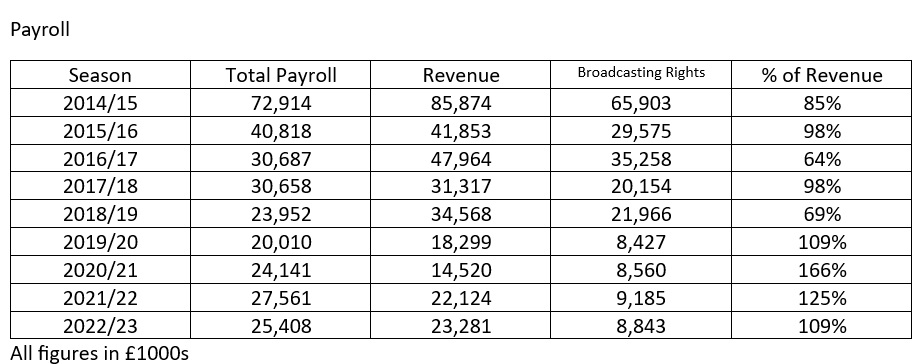 This table clearly shows the wage bill being repeatedly slashed following the club’s relegation from the Premier League at the end of the 2014/15 season in line with the reduction of revenue mainly due to falling broadcasting rights (which include parachute payments). The loan signings of Austin, Johansen etc. in January 2021 significantly reversed this trend and the impact that their permanent signings in the close season the following summer made was enormous. Thankfully the latest set of accounts, released this week, show the total payroll started to come down in the 2022/23 season, but the likes of Leon Balogun and Jake Clarke-Salter along with the loan deals for Ethan Laird, Tim Iroegbunam, Jamal Lowe and Tyler Roberts ensured that it remained far too high for a club with our revenue. 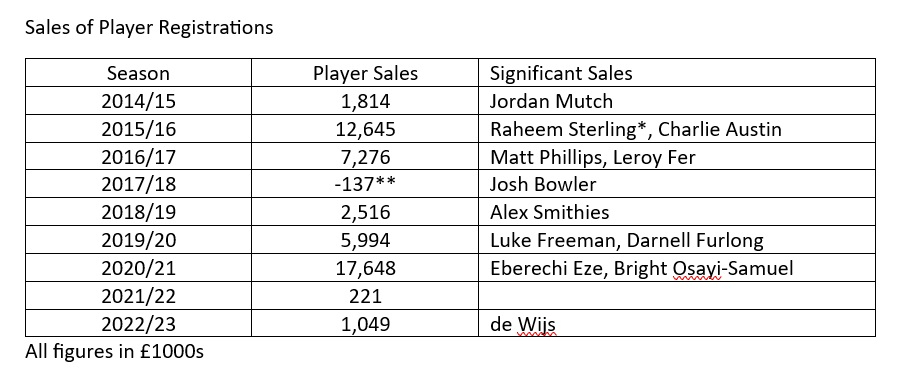 * The Sterling “sale” refers to QPR’s sell-on clause activated by his transfer from Liverpool to Manchester City. The club’s stated policy of developing players and selling them for a profit started to make an important contribution to the club’s revenue in the 2018/19 season and, while not every season can be expected to be as fruitful as 2020/21, completely abandoning it, particularly on the back of an unrewarding season, left a gaping hole in the club’s precarious finances. The headline figures from QPR’s 2022/23 accounts have already been thoroughly dissected elsewhere… Message board threads here, and here or Niall Rogers’ annual Twitter thread here. Rather than retread that ground, I’m going to highlight some cash flow items instead. Whereas the club’s profit and loss statement is subject to accounting jiggery-pokery and can, within legal limits, be manipulated by interpretation, cash flow is fact. As its name suggests, it is simply tracking the money coming in to and going out of the club. As a general rule, a business can sustain losses as long as the cash flow remains good. Before getting to the table, it is probably important to clarify what is meant by the heading at the top of the third column - Cash Inflow (Outflow) from Operating Activities. Included in a club’s profit (loss) are a number of transaction where no money either goes into or out of the club’s bank account. Typical examples of this would include depreciation of any tangible assets such as their stadium, amortisation of the purchase cost of the players (intangible assets) and any impairment of their remaining net book value. Impairment is reducing the book value of a player over and above the annual amortisation. When QPR were relegated at the end of the 2014/15 season they applied an impairment charge of slightly over £11.5m which had the effect of pulling the cost into a season where there was some FFP headroom while lessoning the burden of amortisation on later seasons. A further difference between the Cash Inflow (Outflow) from Operating Activities and the club’s profit (loss) are transactions which enjoy extended credit terms. Eberechi Eze’s transfer to Crystal Palace is a prime example of this. The whole of the profit (excluding add-ons) will have been accounted for in the 20/21 accounts, but only half of the money was received in that period, with Palace paying the second tranche the following season. 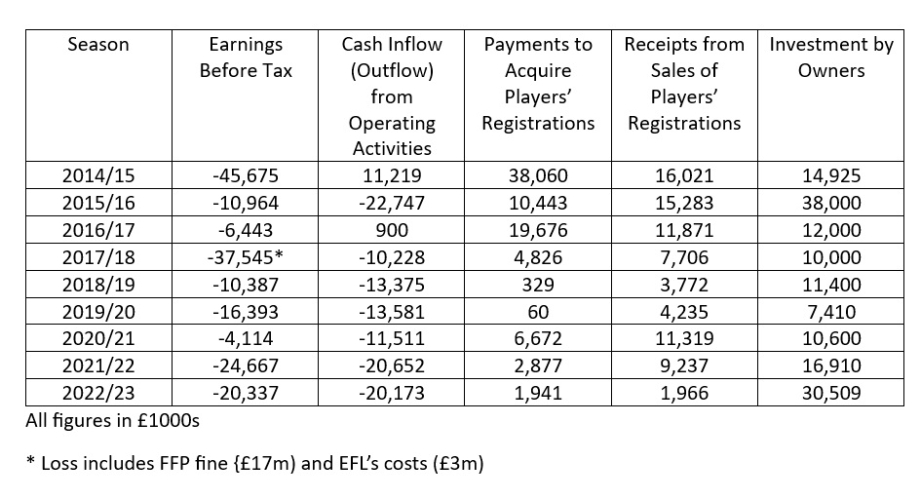 The huge increase of investment by the owners for the 2022/23 season includes a significant investment in the club’s new training facility at Heston as well as the effect of far lower receipts from the sales of players’ registrations. There are many other factors which would need to be included to show the complete picture, such as expenditure on the new training facility, but hopefully this table gives a flavour of the relationship between player trading and the investment required by the shareholders to cover the club’s losses. The all-important question is where do these accounts leave the club with regards to FFP. As a probably unnecessary reminder, Championships clubs are permitted losses of up to £39m over a rolling three-period. In addition to infrastructure projects, any transactions related to our historic FFP fine and any Covid-19 related costs, expenditure such as infrastructure projects, youth development, community schemes and women’s football are excluded from the FFP calculation. I will continue to use Swiss Ramble’s estimate of £4m for QPR for this. The following table shows where I believe we are. 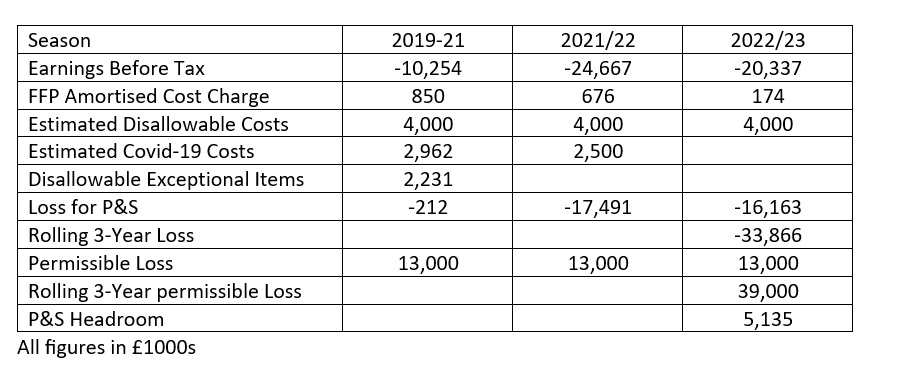 A couple of brief notes before continuing. For full details of why the 2019/20 and 2020/21 seasons are shown as one and how I’ve calculated their Covid costs, please see my year before last’s article Paying Dividends. In an attempt to understate Covid-19 allowances, in last year’s article On the Edge of the Precipice I chose not to include the £2.5m permitted by the FFP regulations for the 2021/22 season, however it is inconceivable that the club didn’t claim it, so I think it is beneficial to do so now. The FFP amortised cost charge is down to the accounting conventions surrounding our FFP fine. I think it will be an unnecessary distraction for me to try to explain how that works. These figures show that QPR had around £5m headroom within their FFP calculation at the end of the 2022/23 season. While this may seem relatively comfortable, it is a big drop form the £15.9m (restated after including the £2.5m Covid-19 allowance) headroom from the end of the previous season. If we then roll these figures forward for another season (2023/24) the picture gets even more bleak. The combined 2019/20 and 20/21 seasons, which include the sale of Eze, get replaced by a season with no major sale and no Covid-19 allowances. 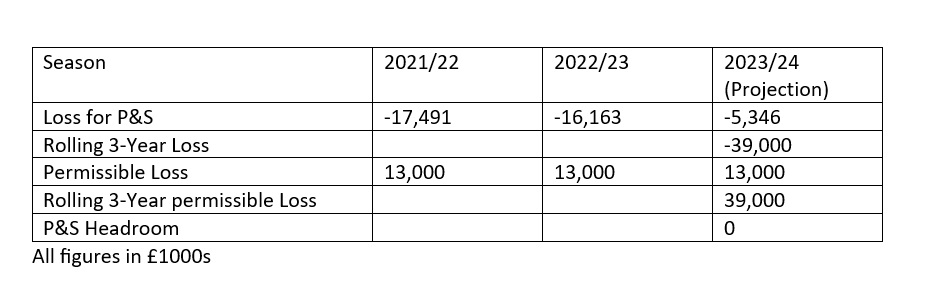 QPR’s loss has to decrease by £10.8m to avoid breaching FFP. This does assume that the £4m disallowable costs is accurate and that there aren’t any other factors that I’ve missed. Only the club and the EFL will know for certain, but it does broadly agree with the predicament ill-advisedly described by Beale in a supporters’ meeting at the beginning of last season. It is hard to see how this reduction has been made. The sale of Seny Dieng to Middlesborough and of Rob Dickie to Bristol City over the summer was an important step, but the club is a heavily reliant on reducing the payroll to achieve it. Among others, presumed high earners such as Leon Balogun, Luke Amos and Chris Martin were released at the end of their contracts, while loanees Ethan Laird, Tim Iroegbunam, Jamal Lowe and Tyler Roberts all returned to their parent clubs. This season is the first that QPR have started without a single player on loan for many years. Stefan Johansen left by mutual consent which would have made a partial saving on his wages, but the majority of these players were replaced, albeit with players on lower wages. The accounts state that the net impact of post year end player trading is £1.775m inflow. The word inflow suggests to me that this is a cash figure rather than profit. Both Dickie and Johansen would have had a residue net book value, the unamortised portion of their transfer costs, which needs to be taken into consideration. The club finally awoke to the revenue that can be made by selling naming rights. The MATRADE Loftus Road Stadium was swiftly followed by the Achilleus Security Stand, The Bhatia Stand and the TSG Elite Training & Performance Centre. Other noteworthy savings include both Les Ferdinand and Chris Ramsey leaving their roles at the club and a contract extension for Lyndon Dykes which will have spread the annual amortisation of his residue net book value over a longer period.
On the face of it, that doesn’t look like a big enough reduction in cost. However, the fact that, on the strength of loaning out Andre Dozzell, Charlie Kelman and Stephen Duke-McKenna, the club felt able to sign Lucas Andersen and Michael Frey as well as taking Isaac Hayden and Joe Hodge (reportedly on remarkably good terms) on loan would suggest otherwise. It does make you wonder how much money we were paying some of the now departed players. Football League clubs have to submit their Future Financial Information to the EFL by March 1st. This is projected accounts for the current season. I would suspect that QPR will be high on their list to scrutinise and would expect any bad news would be leak out relatively quickly. The longer we hear nothing, the more comfortable I will feel. I’ve read a few comments about the owners showing a lack of ambition, but nothing could be further from the truth; it is their over ambition that has put the club in this position. I have every sympathy with, and would fully support, a business model of financially positioning the club for a promotion push every three years to dovetail with FFP reporting periods, but to do so on two consecutive season was reckless. Combining this with a policy of allowing the manager to dictate transfer policy over the man charged with giving the club a long-term strategy, has left us with no discernible direction, an unbalanced squad and staring relegation in the face.
I know that some see relegation as an opportunity to rebuild without being encumbered by the Championship’s FFP regulations due to different criteria being employed by the EFL at that level. While this is true all the time a club stays out of the Championship, on promotion back to it the club returns to being assessed on a three-year rolling period which will include any seasons out of the Championship. The regulations make no exceptions for clubs promoted from League One, the loss thresholds relate to members of “The League” not specifically the Championship. There is no carte blanche to throw pots of money at our problems before returning stronger than before and nor should there be. It could be argued that the cost of running a dilapidated, old stadium in London, the lack of any non-match day revenue and struggling to attract the local young talent to the club due to the more attractive alternatives on our doorstep made this position inevitable, but other clubs cope with similar. As grateful as I am to the owners for their incredible benevolence, unless they address their failings, contain their ambition and adhere to a properly costed business plan, I fear we are going to continue to be, as Bowie once put it, always crashing in the same car. Also by this author >>> Edge of the precipice – Column >>> Paying Dividends >>> Grounds for Concern >>> Gordon Jago: Leading From The Front >>> The Trust >>> Accounting for success >>> Gambling with FFP >>> The greater evil >>> Terry Venables: My first hero >>> QPR’s fairytale of New York If you enjoy LoftforWords, please consider supporting the site through a subscription to our Patreon or tip us via our PayPal account loftforwords@yahoo.co.uk. Pictures — Action Images The Twitter @loftforwords Ian Randall Photography Please report offensive, libellous or inappropriate posts by using the links provided.
You need to login in order to post your comments |
   Blogs 31 bloggersUnited by Football, Divided by Race? Swansea City’s Asian Footballers and Racism in British Football by KeithHaynes Harrison who is studying towards a media qualification has written a very interesting piece on racism in football. It’s a very clear and well documented report. Follow him on X. @HYE15h. Football is often seen as a sport with a unique power to bring people together, connecting people from all over the world with different cultures, races and religions. 128 nations have featured in the topflight of English football, including 12 Asian nations. I have seen for myself how football connects people who otherwise have little in common through my support of Swansea City. These connections are epitomised by an exchange I had with South Korean tourists during a visit to London in August 2015. My three brothers and I were wearing our Swansea shirts, which South Korean tourists recognised because the South Korean captain, Ki Sung-yueng, was playing for our team. We connected over our shared admiration for Ki before having photos together. However, despite the unity football creates, racial incidents challenge the belief that football is a game for all. Kick It Out data shows there were 1,744 reports of discrimination, a record high last season, whilst racism reports against South Asians increased by 100%. This season we’ve already seen racial abuse allegedly directed at Swansea City’s Ji-Sung Eom during a game against Millwall. Former Swansea British Asian player Yan Dhanda was also subjected to racist messages online in 2021. Ki’s experience of racist chanting in Scotland in 2010 before joining Swansea shows that racism against Asians in British football is not a new phenomenon. In light of these incidents I will analyse the impacts of racial abuse against Asian players and football more widely, and ask if enough is being done to stop it. There are a multitude of different impacts from racial abuse within football, most notably the damage to player welfare. Yan Dhanda talked about the hurt he felt in the aftermath of his attack, stating how it affected both his family and how he was in training. Research by Osinnowo Kolawole reveals how the long-term emotional damage of racism is often unseen, affecting both personal lives and their performance. Racism can also lead players to question whether they want to continue playing football, as seen with Danny Rose. Osinnowo further states how racial trauma can lead to deep internal conflicts, with players altering their appearances to conform to white norms in football. For Lee Chun-Soo a former South Korean international footballer racist abuse left him with a desire to build a larger physique as a way of preventing further abuse. He believes the racial stereotypes about Asian players being small and weak results in a reluctance to recognise Asian players as equal competitors. This provides an example of an Asian player having to change who he is to be accepted into the sport, Lee and other victims of racism state how it can lead them to question their sense of belonging in the game. Premier League video content creator Kevin Yuan often faces racist abuse when filming at UK stadiums, despite living in the UK and following football since 2008, he states how he “feels like a foreigner, like I don’t fit in”. This challenge to a player’s sense of not belonging within the game has also had a severe impact on Asian participation with football in Britain, with just over 1% of professional players being of South Asian heritage. Whilst there are many factors which underpin this underrepresentation, racial abuse definitely plays a role. Research by Dr Stefan Lawrence reveals that overt racism within football academies from other players, makes British Asians feel like outsiders. Yan Dhanda talks about how during his time in football academies he was always told he wouldn’t make it due to his Asian background. For other Asian players lacking self-belief and support, abuse can prevent progression. Separate Asian teams and leagues have emerged in direct response to racism; these are seen as safe spaces for Asian players. Dr Lawrence has found that these separate teams and leagues do not have the same level of exposure as mainstream leagues, whereby they aren’t seen by scouts as repositories of talent. Furthermore, the lack of professional Asian players as role models not only limits young Asian players’ beliefs, but also limits coaches’ and scouts’ beliefs in what Asian players they are assessing could become. Seeing the few professional Asian players subjected to racial abuse risks discouraging the next generation from pursuing football. To combat racism in British football, a range of initiatives have been implemented by the leagues, clubs and organisations such as Kick It Out and Show Racism The Red Card. Whilst reports of racism are at a record high, this doesn’t necessarily mean that there is greater racism within football. More reports against racist abuse suggest people are more willing to report racist abuse when they see it, standing up to racism. Since 2022, Kick It Out has run fan education programmes for 500 fans referred by clubs or police, with a reoffending rate of just 1.25%. This shows the impact education can have in tackling racism. However, with 792 reports of racism in 25/26 season alone, many more of these programmes are needed to cover all the perpetrators of racist abuse. An increase of reporting by the media in highlighting racism within football can also be seen. For example, Sky Sports’ “Football’s Hidden Talent” series highlights the racism and inequality South Asians face in football. The racist incident against Ki in 2010 only making the local newspaper, compared to the nationwide and international coverage of the racial abuse against Eom, shows the heightened media coverage of racism in football. Whilst attitudes towards tackling racism have seemingly improved, there are still drawbacks. On-pitch protocols in dealing with racist abuse which were followed during the incident with Eom led to a 7-minute break in play, which afterwards was criticised by the Millwall manager for “killing the momentum”. Such comments were heavily criticised within the game for prioritising momentum over player welfare. An increasing number of Asian players in British football has coincided with Asians taking up a greater share of racism victims. Whilst more people are willing to report racism within the game, this has only revealed the great scale to which racism remains deep rooted in the game. In addressing this problem, harsher sanctions against perpetrators are needed. Cracking down on racism is crucial in addressing the underrepresentation of Asian players in professional football. The lived experiences of Asians in British football expose inequalities in who feels they belong within football. Football should be a game for all, with everyone equally included, whilst it connects so many, in its current state too many are left out. Swansea City has been at the forefront of taking action against racism within football. It was the first club to stage a social media boycott in April 2021 after abuse against Yan Dhanda, Ben Cabango and Jamal Lowe. A second boycott, which Swansea City participated in later that month involved other clubs and sports organisations across the world, representing a combined following of 1.7billion. Swansea City’s resolute actions against racism are reflective of one of the club’s strategic pillars ‘Cymdeithas’, which places the community, togetherness, and belonging at the heart of the club’s identity. It is an ethos that extends beyond the football pitch reflecting the importance of creating an environment in which everyone feels welcome and valued. The unwavering support shown towards Eom by the Jack Army in the aftermath of the alleged racist abuse he experienced, provides an illustration of these values in practice. Ultimately this piece has sought to highlight the very real and immediate impact that racial abuse can have on footballers, and why such behaviour cannot simply be dismissed, ignored, or accepted as part of the game. Eom Ji-sung’s experience is not an isolated incident, but forms part of a wider history of racial discrimination experienced by Asian players within football, including those who have represented Swansea City. While the club’s response and the unwavering support shown by supporters towards Eom provide encouraging examples of what football can represent at its best, there remains much work to be done in the fight against racism. My best wishes go to Eom, with the hope that the support of Swansea City and the Jack Army remains far louder than the abuse he has faced. Bibliography Premier League, 13 September 2025, https://www.premierleague.com/ Sky Sports, 31 July 2025, https://www.skysports.com/foot Andrew Raeburn, BBC Sport, 14 October 2026 https://www.bbc.co.uk/sport/fo BBC Sport, 11 February 2021, https://www.bbc.co.uk/sport/fo The Courier, 2 November 2010 https://www.thecourier.co.uk/s Swansea City AFC, 18 February 2021, Swansea City AFC, 8 April 2021, https://www.swanseacity.com/ne Swansea City AFC, 13 May 2021, https://www.swanseacity.com/ne Osinnowo, Kolawole, 2024, Exploring the Experiences of Racial Trauma among Footballers. https://uhra.herts.ac.uk/id/ep BBC Sport, 4 April 2019 https://www.bbc.co.uk/sport/fo Lee Chun-Soo, 23 October 2026, Nizaar Kinsella, BBC Sport, 20 November 2024, https://www.bbc.co.uk/sport/fo Kick It Out, 30 September 2026, https://www.kickitout.org/site COPA90, 24 January 2019, Gareth Vincent, BBC Sport, 12 November 2020, https://www.bbc.co.uk/sport/fo Sky Sports News, 25 May 2024, Sky sports, 31 July 2026, https://www.skysports.com/foot Kick It Out, 30 September 2026, https://www.kickitout.org/site Sky Sports News, 25 May 2024, Queens Park Rangers Polls[ Vote here ] |
 By continuing to use the site, you agree to our use of cookies and to abide by our Terms and Conditions.
We in turn value your personal details in accordance with our Privacy Policy.