
Mad about the Boy – Signing Saturday, 20th Jun 2026 13:55 by Clive Whittingham and Zac Bowles QPR’s summer recruitment for 2026 begins with the addition of Dutch left back Boy Kemper on a free transfer from NAC Breda in the Netherlands. FactsBoy Kemper is a 26-year-old (27 tomorrow), 6ft 1ins left sided defender from Plumerand in the west of the Netherlands. He played his initial youth football with FC Volendam (recently relegated from the Eredivisie) before being picked up by giants Ajax for 2016/17 when he was just 17 years old. He made his debut in the second tier of Dutch football for Ajax Jong (effectively Ajax B) a year later against SC Cambuur. He picked up four caps for the Netherlands at U18 level and another six for their U19s during this time. Ahead of the 2020/21 season he was signed by top flight side Den Haag where he made 24 starts and two sub appearances, scoring a first senior goal in a 1-0 away win at RKC Waalwijk (and we’ll hear more from their second album, later in the show). That wasn’t enough to prevent them being relegated to the second tier of Dutch football, however, where Kemper spent the next two seasons of his career eventually racking up 83 appearances and four goals. In June 2023 he moved to NAC Breda on a three-year contract. In his first season he was captain of a side that went on remarkable run to Eredivisie promotion through the play-offs. Breda finished eighth in the second tier but fought their way through four games in the end of season knockout, beating Roda, FC Emmen, and finally Excelsior Rotterdam over two legs in which a 6-2 victory in the home game was nearly turned into a very-QPR-indeed aggregate loss when they were beaten 4-1 away, eventually squeaking up 7-6 on aggregate. Back in the top flight he started 28 games with one sub appearance in 2024/25, scoring in a 2-0 away win at Sparta Rotterdam in December. In 2025/26 he played 32 times as captain of the side and scored career-best five goals (with three assists into the bargain) in games against Heracles, Nijmegen, a 2-2 draw with mighty PSV Eindhoven, and two in the final game against Heerenveen (one of them an absolute shitpinger). Unfortunately, it wasn’t enough to prevent Breda finishing second bottom (6-11-17) and being relegated. Kemper was linked with a move to sixth placed Utrecht this summer but QPR have picked him up on a free transfer at the end of his Breda deal and according to Dutch media he has signed a three-year contract at Loftus Road with an option for a fourth. Good to get this one over the line before he becomes Man Kemper and his resale value goes down. Analysis Zac Bowles @TheLoftInsightsWith the end of Rhys Norrington-Davies’ loan spell leaving QPR with just two left-backs at the club (Ziyad Larkeche and Esquerdinha), the pick-up of 26-year-old NAC Breda captain Boy Kemper on a free transfer appears to be a sensible bit of business. But what can we actually expect from our new Boy? 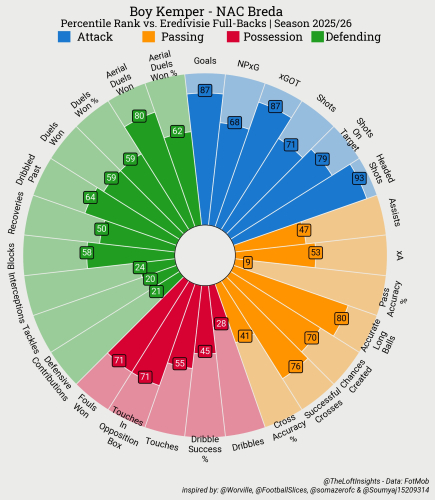 In possession When NAC have the ball, Kemper frequently looks to get forward, playing primarily in the middle and final thirds. He often gets into advanced attacking positions, which should suit Stéphan’s tactical preference for inverted wingers. Kemper looks to deliver the ball into the box often, registering 0.7 crosses/90 last season and producing two assists last season from crossing positions. However, ball delivery is not a particular strength of Kemper’s, as he (somehow) registered a lower cross completion rate than Amadou Mbengue last season (19.1% vs. 20.6%). Kemper produced an unremarkable 0.12 xA/90 (which would rank him 25th among Championship full-backs last season), creating 1.18 chances/90. On the ball, Kemper is an infrequent dribbler, mainly receiving the ball in space from third man runs; he recorded 0.32 dribbles/90 with a success rate of 43.5% last season. He is also a direct passer, recording 2.39 accurate long balls/90, which again should suit Stéphan’s counter-attacking approach. An area where Kemper shines is in the final third, as he likes to crash the box, getting into goalscoring areas. Kemper produced some impressive attacking numbers last season, scoring five goals, producing 0.07 NPxG/90 and registering 0.96 shots/90. He also strikes the ball well; Kemper was NAC Breda’s penalty taker last season. Physicality Naturally, coming from the Eredivisie to the Championship, there may be questions surrounding Kemper’s ability to adapt to the physical demands of the league. Watching him play, Kemper is strong and, by all accounts, a bit of a shithouse. He won 5.26 duels/90 last season - a similar figure to RND’s 5.58 per 90 - and so there should be little concern in his ability to adapt to the physicality of the English game. Kemper is also an aerial presence, making him a threat from set-pieces; he scored one headed goal and recorded one headed assist last season, also winning 2.17 aerial duels/90. Where there should be some concern, however, is Kemper’s ability to adapt to the speed of the Championship. Kemper is quite slow off-the-ball (watch back the speed of his underlap for his second crossing assist, for example) and given the fact he positions himself further up the pitch, this means he can struggle to track back during defensive transitions. This can leave the left-hand side exposed to counter-attacks if possession is lost in the middle third, which is particularly concerning given QPR conceded the second most goals from fast breaks (ten) in the Championship last season. Out-of-Possession Finally, looking at Kemper’s out-of-possession performance, he appears reliable, if unremarkable, with a very similar output to Rhys Norringtton-Davies. Kemper recorded 5.58 defensive contributions per 90 (RND: 5.87), including 1.6 tackles (RND: 2.11) and 0.73 interceptions (RND: 0.74) last season. I expect he should perform similarly to RND for QPR, but given his physical limitations, I do expect Kemper to struggle against some of the faster wingers in the division. Conclusion Overall, while I honestly don’t believe Kemper will set the world on fire in W12, he is clearly a very pragmatic signing, essentially replacing Norrington-Davies on a free transfer. At 26, Kemper brings experience captaining an Eredivisie side, where he was ever-present last season, playing 2,821 out of a possible 3,060 minutes. Ultimately, if he can adapt to the demands of the Championship, there is no reason he can’t be a reliable solution to our depth problem at left-back. Reaction“First of all. New club, new city, new competition - I'm looking forward to start and see all the guys. For me, it's also a big challenge to get the club where they belong - a club like this belongs in the highest level. I’m a hardworking defender, can go up and down, good cross, can give the final pass, assist, and defending, very, very solid. I think there will not be a winger that will say they like to play against me. I think you learn a lot because you have different players from different countries, different ages, so you have to communicate in your own way to be sure that everyone feels good and can be their best on the pitch. I'm vocal on the pitch but next to the pitch, I can be a nice guy to give someone what he needs. When you're on the pitch, I think it's important that you be vocal and show what you want as a team." -Boy Kemper “We are excited to welcome Boy to QPR. He brings tenacity, physicality, aerial ability, a cultured cross and a venomous strike. As a character, we believe that Boy will fit right into this group that continues to display immense work ethic day-to-day - and that he will help to foster that even further.” -Christian Nourry OpinionBoy Kemper is the opening gambit of what I think could be an incredibly interesting summer for Queens Park Rangers. One that will tell us a lot about the ambition of the club and its direction of travel. QPR have a hell of a lot going for them in 2026/27, probably more so that at any point in the last five years. Two outstanding teams at this level have gone up to be replaced by three in various states of crises – Burnley don’t have a manager, Wolves did but have already got rid, West Ham’s owner is finally getting what’s long been coming to him. Unlike last year, when Wrexham and Birmingham arrived with American war chests at their disposal, there are no big hitters arriving from League One. The best of the promoted teams, Lincoln City, have already lost their manager to Bristol City. Two big clubs, in Sheff Wed and Leicester, have departed the other way. The division is undoubtedly weaker than it was in 2025/26 and this year, for the first time, finishing eighth is enough to buy a ticket in the end of season lottery. Although the highest QPR have managed in ten years is ninth, when you look at the teams that have finished seventh and eighth of late (Wrexham, Derby; Blackburn, Millwall; Hull, Boro; Blackburn and Millwall again; Boro again, Blackburn again; Reading, Cardiff) it shouldn’t be an insurmountable hurdle. Things have fallen nicely for us here. In Richard Kone and Rumarn Burrell, Rangers have done the most difficult and expensive bit of their recruitment already. Two strikers, 25 or younger, great physical profile, double figure Championship seasons already recorded, there aren’t many more exciting potential pairings in the division this year than those two. Like some of the club’s other promising recruits (Nicolas Madsen, Harvey Vale, Ronnie Edwards, Amadou Mbengue) they already have a season (or two) at this level under their belts so should now be fully up to speed and ready to hit their straps. Likewise, manager Julien Stéphan who will have learnt a lot from his first year at this level. Of course, getting them on the pitch in our colours is going to be key. QPR need to start selling players soon and a combination of injury and lousy form has severely dented their chances of getting this summer’s planned cabs (Dembele, Varane) off the rank at any sort of price. Richard Kone will likely attract interest this summer. The club also has to get a grip of the injury situation and make sure its best players are on the field more often than not. Assuming they are genuinely reviewing and tackling that issue, not jamming their fingers in their ears and hiding behind this “90% availability” codswallop, then you’d think we’re in for a better season than last. You’d have to be very unlucky/incredibly incompetent to have a third consecutive season with the quantity and quality of injuries we’ve had in the last couple. While squad depth will always be an issue on our budget, and we desperately need the development team to convert its nice shiny cup wins into some genuine first team prospects to aid in that, the starting 11 isn’t far off when it’s fit and firing. The issues with it are obvious. Even among the polarised opinions of the club’s online fanbase there is consensus that we are weak in goal, at full back, and in central midfield. What we do with those positions, what the team looks like come September 1, will tell you a lot about our ambition, and where we see the club going. Surgery has already started on the midfield where Isaac Hayden and Sam Field have departed and the really good news is two of the three positions we need are in plentiful supply and are not expensive. The top three goalkeepers in the Championship and League One last year, per Opta stats, were all on loan. Three of this division’s top four teams last year had a loan goalkeeper. Premier League clubs have hoarded keepers in recent years, good ones are in plentiful supply on the loan market. If you’re happy finishing 15th in the Championship every year as long as the average age is coming down, the development squad is winning pots and pans, and in theory you’re developing prospects to sell, then Joe Walsh covered by Murphy Cooper, Ziyad Larkeche covered by Esquerdinha, Jonathan Varane turning every attack into a pass back to the goalkeeper, is probably fine. But if Kone and Burrell are here at the start of September, and the fitness situation does improve, then a decent goalkeeper, full back and centre mid could take elevate this team quite considerably. Hull, now heading to the Premier League, were not a great side. Of course, as ever, there is a financial element to wrap our heads around. There’ll be signings. It’s QPR, of course there’ll be signings. But how many, and in what profile, will be intriguing. The club has spent big money by its standards over the last two seasons. First on the Celar/Madsen/Varane/Santos intake, then again on Mbengue/Kone/Burrell/Poku a year ago, and again in January on Edwards and the man, myth and legend Justin Obikwu. A good chunk of that has been offset by the sales of Kelman, Dykes, Armstrong and a sell-on for Ebere Eze, but we’ve been talking about that Eze sell-on for a long time and that’s here now. Christian Nourry was confident at the recent fan sites meeting that the new PSR version of FFP wouldn’t be a problem for us, but a club running at 100%+ wages to turnover is always going to have to wrestle a rule that says you can only lose 85% of what you bring in and the club has already spent the summer making a number of unpleasant decisions – jacking up concessionary season tickets, charging £60 for a collection of distinctly mediocre replica shirt designs, slapping an online casino on the front of those shirts – to try and get more revenue into the building. Kemper is a signing that speaks to all of this. He’s a left back, one of the problem positions that was last year covered by a loan, and it is a relief to me that we’re not going to attempt a season with Larkeche covered by Esquerdinha which would have just been asking for trouble. That’s a good start. His stats say he’s a lot better going forwards (five goals and three assists last year) than Rhys Norrington Davies was (one goal, zero assists). He’s a big, aggressive unit which addresses another concern about our team being too small, too weak, too meek while football as a whole heads in completely the opposite direction towards physicality, set pieces, and directness. His reports from Holland suggest he’s one of those Ben Pearson characters who hate until he plays for your team, and that’s a positive for me – captain of his last club, plenty of gob on him. We need an edge. QPR only kept six clean sheets away from home last season and three of those (Swansea, Blackburn, Sheff Utd) were with Sam Field at left back. And we need leadership as what experience we did have bleeds out of the squad in a myopic quest to get our average age to the lowest in the league. A big, confident, aggressive Dutchman on that side of the defence is just what I want right now. That comes with all the usual caveats about signings from the Eredivisie that we trotted out when Kennth Paal came, and George Cox nearly did – 34 game season not 48, much less physical than the Championship, and he’s already been relegated at that level twice in his career. Kemper played for Breda last year who went down, but his other option this summer was Utrecht who finished sixth. There are red flags in Zac’s analysis above about lack of speed and vulnerability against quick wingers. In a year’s time will we once again be talking about QPR looking to find value in the European market while underestimating the demands of the league they play in themselves? His physical profile doesn’t suggest he’ll be bullied at least, more doing the bullying himself, and as a free transfer the price is right. It a signing that shows learning about where the team was poor last year, and our lack of physicality in an increasingly aggressive modern game. Now let’s see what they’ve got for us between the sticks, and in the centre of the park. If you enjoy LoftforWords, please consider supporting the site through a subscription to our Patreon or tip us via our PayPal account loftforwords@yahoo.co.uk. Pictures - Reuters Connect Please report offensive, libellous or inappropriate posts by using the links provided.
You need to login in order to post your comments |
   Blogs 31 bloggersUnited by Football, Divided by Race? Swansea City’s Asian Footballers and Racism in British Football by KeithHaynes Harrison who is studying towards a media qualification has written a very interesting piece on racism in football. It’s a very clear and well documented report. Follow him on X. @HYE15h. Football is often seen as a sport with a unique power to bring people together, connecting people from all over the world with different cultures, races and religions. 128 nations have featured in the topflight of English football, including 12 Asian nations. I have seen for myself how football connects people who otherwise have little in common through my support of Swansea City. These connections are epitomised by an exchange I had with South Korean tourists during a visit to London in August 2015. My three brothers and I were wearing our Swansea shirts, which South Korean tourists recognised because the South Korean captain, Ki Sung-yueng, was playing for our team. We connected over our shared admiration for Ki before having photos together. However, despite the unity football creates, racial incidents challenge the belief that football is a game for all. Kick It Out data shows there were 1,744 reports of discrimination, a record high last season, whilst racism reports against South Asians increased by 100%. This season we’ve already seen racial abuse allegedly directed at Swansea City’s Ji-Sung Eom during a game against Millwall. Former Swansea British Asian player Yan Dhanda was also subjected to racist messages online in 2021. Ki’s experience of racist chanting in Scotland in 2010 before joining Swansea shows that racism against Asians in British football is not a new phenomenon. In light of these incidents I will analyse the impacts of racial abuse against Asian players and football more widely, and ask if enough is being done to stop it. There are a multitude of different impacts from racial abuse within football, most notably the damage to player welfare. Yan Dhanda talked about the hurt he felt in the aftermath of his attack, stating how it affected both his family and how he was in training. Research by Osinnowo Kolawole reveals how the long-term emotional damage of racism is often unseen, affecting both personal lives and their performance. Racism can also lead players to question whether they want to continue playing football, as seen with Danny Rose. Osinnowo further states how racial trauma can lead to deep internal conflicts, with players altering their appearances to conform to white norms in football. For Lee Chun-Soo a former South Korean international footballer racist abuse left him with a desire to build a larger physique as a way of preventing further abuse. He believes the racial stereotypes about Asian players being small and weak results in a reluctance to recognise Asian players as equal competitors. This provides an example of an Asian player having to change who he is to be accepted into the sport, Lee and other victims of racism state how it can lead them to question their sense of belonging in the game. Premier League video content creator Kevin Yuan often faces racist abuse when filming at UK stadiums, despite living in the UK and following football since 2008, he states how he “feels like a foreigner, like I don’t fit in”. This challenge to a player’s sense of not belonging within the game has also had a severe impact on Asian participation with football in Britain, with just over 1% of professional players being of South Asian heritage. Whilst there are many factors which underpin this underrepresentation, racial abuse definitely plays a role. Research by Dr Stefan Lawrence reveals that overt racism within football academies from other players, makes British Asians feel like outsiders. Yan Dhanda talks about how during his time in football academies he was always told he wouldn’t make it due to his Asian background. For other Asian players lacking self-belief and support, abuse can prevent progression. Separate Asian teams and leagues have emerged in direct response to racism; these are seen as safe spaces for Asian players. Dr Lawrence has found that these separate teams and leagues do not have the same level of exposure as mainstream leagues, whereby they aren’t seen by scouts as repositories of talent. Furthermore, the lack of professional Asian players as role models not only limits young Asian players’ beliefs, but also limits coaches’ and scouts’ beliefs in what Asian players they are assessing could become. Seeing the few professional Asian players subjected to racial abuse risks discouraging the next generation from pursuing football. To combat racism in British football, a range of initiatives have been implemented by the leagues, clubs and organisations such as Kick It Out and Show Racism The Red Card. Whilst reports of racism are at a record high, this doesn’t necessarily mean that there is greater racism within football. More reports against racist abuse suggest people are more willing to report racist abuse when they see it, standing up to racism. Since 2022, Kick It Out has run fan education programmes for 500 fans referred by clubs or police, with a reoffending rate of just 1.25%. This shows the impact education can have in tackling racism. However, with 792 reports of racism in 25/26 season alone, many more of these programmes are needed to cover all the perpetrators of racist abuse. An increase of reporting by the media in highlighting racism within football can also be seen. For example, Sky Sports’ “Football’s Hidden Talent” series highlights the racism and inequality South Asians face in football. The racist incident against Ki in 2010 only making the local newspaper, compared to the nationwide and international coverage of the racial abuse against Eom, shows the heightened media coverage of racism in football. Whilst attitudes towards tackling racism have seemingly improved, there are still drawbacks. On-pitch protocols in dealing with racist abuse which were followed during the incident with Eom led to a 7-minute break in play, which afterwards was criticised by the Millwall manager for “killing the momentum”. Such comments were heavily criticised within the game for prioritising momentum over player welfare. An increasing number of Asian players in British football has coincided with Asians taking up a greater share of racism victims. Whilst more people are willing to report racism within the game, this has only revealed the great scale to which racism remains deep rooted in the game. In addressing this problem, harsher sanctions against perpetrators are needed. Cracking down on racism is crucial in addressing the underrepresentation of Asian players in professional football. The lived experiences of Asians in British football expose inequalities in who feels they belong within football. Football should be a game for all, with everyone equally included, whilst it connects so many, in its current state too many are left out. Swansea City has been at the forefront of taking action against racism within football. It was the first club to stage a social media boycott in April 2021 after abuse against Yan Dhanda, Ben Cabango and Jamal Lowe. A second boycott, which Swansea City participated in later that month involved other clubs and sports organisations across the world, representing a combined following of 1.7billion. Swansea City’s resolute actions against racism are reflective of one of the club’s strategic pillars ‘Cymdeithas’, which places the community, togetherness, and belonging at the heart of the club’s identity. It is an ethos that extends beyond the football pitch reflecting the importance of creating an environment in which everyone feels welcome and valued. The unwavering support shown towards Eom by the Jack Army in the aftermath of the alleged racist abuse he experienced, provides an illustration of these values in practice. Ultimately this piece has sought to highlight the very real and immediate impact that racial abuse can have on footballers, and why such behaviour cannot simply be dismissed, ignored, or accepted as part of the game. Eom Ji-sung’s experience is not an isolated incident, but forms part of a wider history of racial discrimination experienced by Asian players within football, including those who have represented Swansea City. While the club’s response and the unwavering support shown by supporters towards Eom provide encouraging examples of what football can represent at its best, there remains much work to be done in the fight against racism. My best wishes go to Eom, with the hope that the support of Swansea City and the Jack Army remains far louder than the abuse he has faced. Bibliography Premier League, 13 September 2025, https://www.premierleague.com/ Sky Sports, 31 July 2025, https://www.skysports.com/foot Andrew Raeburn, BBC Sport, 14 October 2026 https://www.bbc.co.uk/sport/fo BBC Sport, 11 February 2021, https://www.bbc.co.uk/sport/fo The Courier, 2 November 2010 https://www.thecourier.co.uk/s Swansea City AFC, 18 February 2021, Swansea City AFC, 8 April 2021, https://www.swanseacity.com/ne Swansea City AFC, 13 May 2021, https://www.swanseacity.com/ne Osinnowo, Kolawole, 2024, Exploring the Experiences of Racial Trauma among Footballers. https://uhra.herts.ac.uk/id/ep BBC Sport, 4 April 2019 https://www.bbc.co.uk/sport/fo Lee Chun-Soo, 23 October 2026, Nizaar Kinsella, BBC Sport, 20 November 2024, https://www.bbc.co.uk/sport/fo Kick It Out, 30 September 2026, https://www.kickitout.org/site COPA90, 24 January 2019, Gareth Vincent, BBC Sport, 12 November 2020, https://www.bbc.co.uk/sport/fo Sky Sports News, 25 May 2024, Sky sports, 31 July 2026, https://www.skysports.com/foot Kick It Out, 30 September 2026, https://www.kickitout.org/site Sky Sports News, 25 May 2024, Queens Park Rangers Polls[ Vote here ] |
 By continuing to use the site, you agree to our use of cookies and to abide by our Terms and Conditions.
We in turn value your personal details in accordance with our Privacy Policy.